


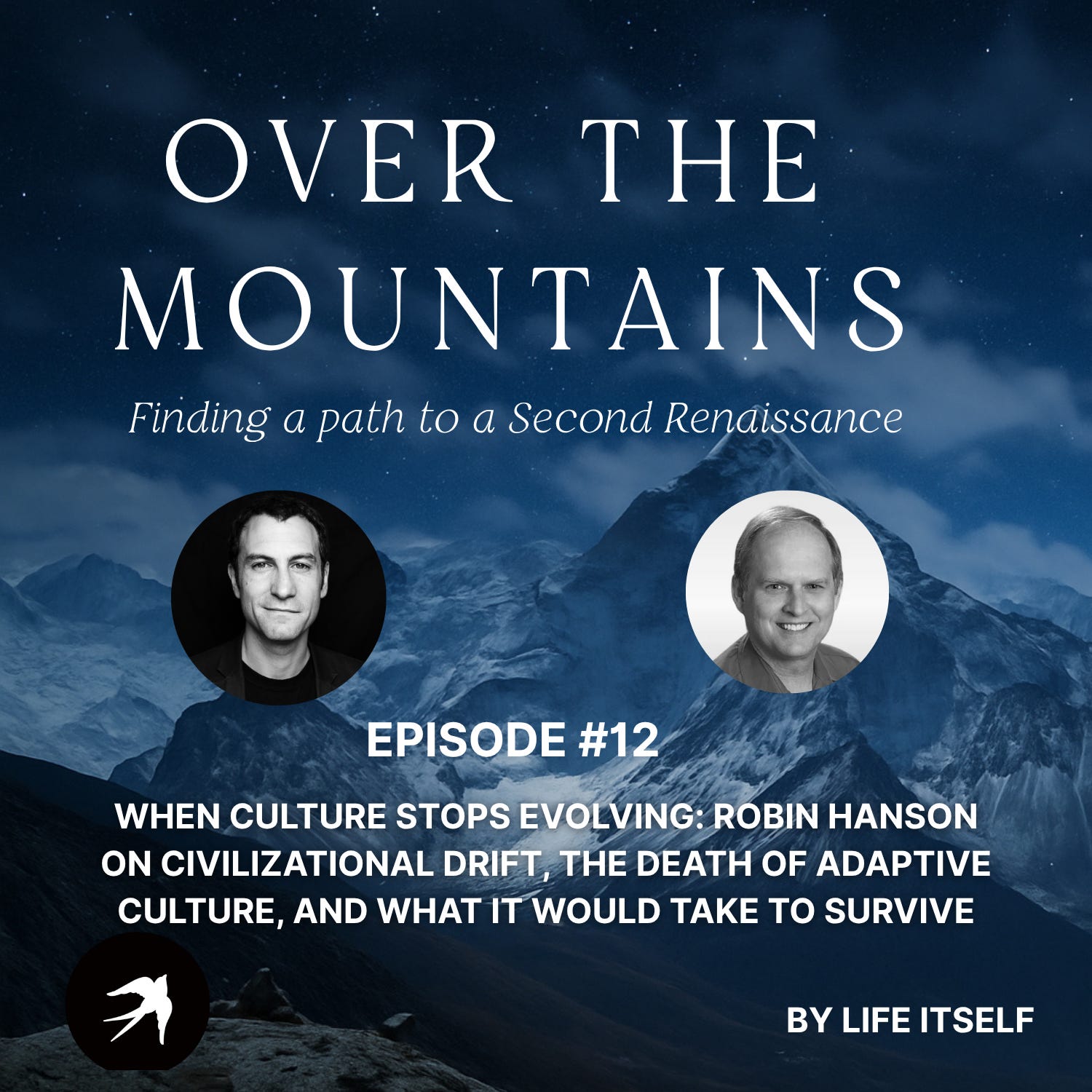
In this episode of Over the Mountains, Rufus is joined by economist and futurist Robin Hanson, who reshapes our understanding of cultural evolution and civilizational collapse, highlighting the importance of curiosity and original thought.
Hanson argues that culture is humanity’s true superpower — a Darwinian process that has historically kept our values and norms fitted to reality. But over the last three centuries, the four key conditions that make cultural evolution work have each quietly shifted into failure: diversity has collapsed into a global monoculture, selection pressures have weakened as wealth insulates us from consequence, the pace of change has outrun our ability to adapt, and internally driven cultural shifts now steer us away from fitness rather than toward it.
"Cultural evolution is the thing that gave you everything you value."
The result, Robin suggests, is a civilisation drifting back toward its default human state, as he puts it plainly, “lazy, selfish, and myopic.” Low fertility, rising mental illness, drug deaths, and the cultural rejection of transformative technologies like nuclear energy are not isolated crises. They are symptoms.
Robin points toward Futarchy as a solution — a radical reimagining of governance built on prediction markets and the principle of “vote on values, bet on beliefs” — and argues that what civilisation ultimately needs is a sacred goal: something vast enough and serious enough to demand real sacrifice.
This is a conversation about evolution, governance, and what it means to build something worth surviving for.
00:00 Introduction to Robin Hanson
01:58 The Journey of Curiosity
06:38 Early Questions and Intellectual Development
09:03 Civilizational Collapse: A Historical Perspective
10:40 Understanding Cultural Evolution
16:44 The Parameters of Cultural Evolution
27:31 The Impact of Globalization on Culture
35:41 The Future of Cultural Evolution
40:24 Egalitarianism and Cultural Evolution
42:34 Navigating Cultural Change
44:51 Global Cooperation vs. Cultural Diversity
45:24 Cultural Adaptiveness and Fitness
48:01 Cultural Drift and Maladaptive Trends
52:26 Reversion vs. Spiral Models in Culture
54:48 Identifying Solutions to Cultural Problems
56:44 Three Levels of Cultural Change
01:01:25 Concrete Solutions for Cultural Trends
01:05:59 Fragmenting Culture and Governance
01:13:38 Adaptive Changes in Shared Culture
01:17:38 Cultural Maladaptation and Mental Health
01:20:18 The Role of Government in Problem Solving
01:20:56 Introducing Futarchy: A New Governance Model
01:28:44 Conditional Markets and Decision Making
01:34:08 Sacred Goals and Civilization’s Future
Speakers
Rufus Pollock is a co-founder of Life Itself, an entrepreneur, activist, an author, as well as a long-term zen practitioner.
Robin Hanson is an economist, futurist, and associate professor of economics at George Mason University. He is the author of The Elephant in the Brain and The Age of Em, the inventor of the governance system known as Futarchy, and the founder of the long-running Substack blog Overcoming Bias.
About Over the Mountains
Over The Mountains by Life Itself is a podcast and blog exploring the understandings and system shifts needed to bring forth a Second Renaissance, to live within a metamodern reality that works for everyone.
The title Over The Mountains is a metaphor for the long and often difficult journey humanity must take together. In a time when many seek shortcuts — especially through technology — this podcast reminds us that those shortcuts can lead to greater destruction. To truly reach the other side, we must climb over the mountain: facing the complexity of collective action, institutional change, and the reimagining of our shared reality.
Over the Mountains focuses on the societal, political, economic, and ontological transformations required for such a world to emerge. Featuring conversations with sensemakers and the builders of tomorrow such as Rufus Pollock, Liam Kavanagh, Sylvie Barbier, Jonah Wilberg and many others, this series shares knowledge from sociology, economics, political philosophy, history, neuroscience, and ideological science, making these insights accessible to a wider audience. The ideas that we will share with you set out some of the reasoning and ideas for the creation of Life Itself and the Second Renaissance initiatives.
Twitter - https://twitter.com/forlifeitself
Website - https://lifeitself.org


